
For graffiti, beginners should start with low pressure spray paint, a few skinny and fat caps, and a respirator mask, and practice can control on a legal wall or a board before trying letters. Spray paint is a very different tool from a marker: most of the skill is in how you hold and move the can, not how you draw.
Paint only on legal walls, your own property, or surfaces you have permission to use. Painting other people’s property is illegal in most places.
What is graffiti spray paint?
Graffiti spray paint is aerosol paint made for artists: a can of pigment, binder and solvent, pushed out by a propellant gas when you press the cap. Compared with hardware-store spray paint, it comes in hundreds of colors, dries fast, covers well, and takes interchangeable caps, so you can switch from a thin line to a wide fill on the same can. For how aerosol paint became the graffiti tool, see our history of graffiti.
Inside every can is a metal mixing ball. Shaking the can rattles the ball and mixes the pigment back into the liquid. Most graffiti paint is solvent-based, often with an acrylic or alkyd binder, which is why it smells strong and needs ventilation. A few brands make water-based spray paint with less smell, which suits indoor projects and canvas.
Low pressure vs high pressure spray paint
Graffiti paint comes in two broad types, and the difference is how hard the paint leaves the can:
| Low pressure | High pressure | |
|---|---|---|
| Flow | Slow, controlled | Fast, powerful |
| Best for | Beginners, lines, detail, fades, canvas | Big fills, covering walls quickly |
| Risk | Takes longer to fill areas | Drips if you hesitate |
| Feel | Forgiving when you move slowly | Needs quick, confident movements |
For learning, start with low pressure: it forgives slow, unsure movements and makes cleaner lines with skinny caps. Many experienced writers carry both, using high pressure cans to fill large areas fast and low pressure cans for outlines and details.
Hardware-store paint such as Krylon or Rust-Oleum is cheaper and easy to find. It works for practicing movements and for primer layers, but it usually has a harder spray, fewer colors and caps that do not swap with graffiti caps.
What do the different spray paint caps do?
The cap, also called the nozzle or actuator, decides the shape and width of the spray. Swapping caps changes what one can can do, which is why writers carry a pocket full of them.
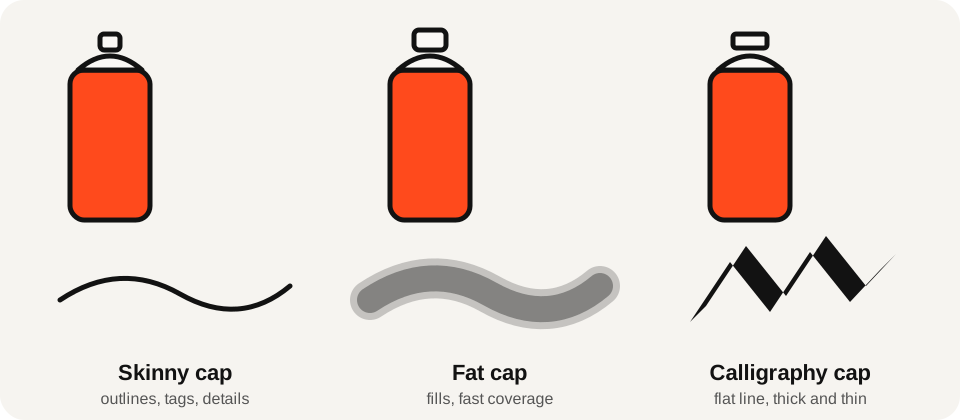
- Skinny caps spray a thin, tight line for outlines, highlights, details and tags.
- Fat caps spray a wide line for fills, backgrounds and covering big areas fast.
- Calligraphy caps spray a flat, narrow fan instead of a dot. Rotate the can and the line goes from thick to thin, like a calligraphy pen, which suits handstyles and lettering.
- Soft or medium caps sit between skinny and fat, with softer edges, for fades and general work.
- Stock caps are whatever comes on the can, usually somewhere in the middle.
Cap names vary by brand, and writers often call them by color or nickname, so check what a cap does before you buy it. Graffiti caps fit most graffiti cans, but many hardware-store cans use a different valve and take only their own caps.
Caps clog over time. Keep a few spares, and after painting turn the can upside down and spray briefly until only clear gas comes out to clear the nozzle. Soak clogged caps in the cleaner that matches the paint (thinner for solvent-based paint, water for water-based) to clear them.
Which spray paint brands do graffiti artists use?
Graffiti artists mostly use brands made for graffiti and murals: Montana Colors (MTN), Montana Cans, Molotow, Ironlak, Loop Colors and Flame are some of the best-known names. Each makes several lines that differ in pressure and finish, so the product line matters as much as the brand.
Our two beginner picks, one low pressure and one high pressure, are at the end of this guide.
A few examples:
- Montana Colors (MTN), from Barcelona, makes MTN 94, a popular low pressure line with a matte finish, and MTN Hardcore, a high pressure line for fast coverage.
- Montana Cans, a separate German company with a similar name, makes Montana Black (high pressure) and Montana Gold.
- Molotow makes spray paint lines as well as the markers covered in our best graffiti markers guide.
- Ironlak, from Australia, and Loop Colors both make graffiti-specific ranges.
- Krylon and Rust-Oleum are hardware-store brands people use for practice, primer and budget fills.
Brand ranges change, and lines get renamed, so read the label or the brand’s own website for pressure and finish. Prices vary by store and country, so they are not listed here.
Can control: the core skill
“Can control” is how cleanly you can put paint where you want it. It is the skill that separates crisp letters from fuzzy, drippy ones, and it only comes from practice. Before every session:
- Shake the can for a minute or two, until the ball inside rattles freely, then shake again every few minutes.
- Test spray on a scrap surface to check the cap and pressure.
- Hold the can upright and keep your arm loose; move from the shoulder, not the wrist.
Most drips come from hesitating or holding the can too close. Keep moving.
Can control drills for beginners
Do these on a board, a sheet of cardboard or a legal wall. Ten minutes of drills before painting letters makes a real difference.
- Straight lines. Pull long horizontal and vertical lines at a steady distance. Start moving before you press and keep moving after you release, so the ends stay clean.
- The distance ladder. Spray the same line at 2, 6 and 12 inches from the surface. Close gives a sharp, thin line; far gives a soft, wide one. Learn how each cap behaves at each distance.
- Flicks. Spray a line and flick your wrist away at the end so it tapers to a point. Flicks are used for highlights and letter tips.
- Dots and circles. Short bursts for dots, then smooth circles in one motion. Circles train the arm curves you need for bubble letters.
- Fades. Spray a block of one color, then blend a second color in with light, quick passes where they meet.
- Outlines on fills. Fill a shape with a fat cap, then outline it with a skinny cap and a contrasting color.
- Cutbacks. Spray the background or fill color along the edge of an outline to clean it up and sharpen it. This is how writers fix shaky lines.
A simple first project
- Sketch your word on paper first. The graffiti generator helps you plan letters and colors.
- On the wall, sketch the outline lightly in a pale color.
- Fill the letters with fat caps.
- Add the 3D or shadow.
- Do the final outline with a skinny cap.
- Finish with white highlights and flicks.
The same order is shown step by step, on paper, in how to draw graffiti. If straight-edged letters are what you want, printable stencil letters are an easy way to get clean results while your can control improves.
How do you spray paint safely?
Spray paint is safe enough when used properly, and harmful when it is not. The fumes contain solvents and fine paint mist that you should not breathe, and the cans are pressurized and flammable.
- Wear a respirator. Use a half-face respirator with organic vapor cartridges and particulate prefilters. A paper dust mask does not stop fumes. Make sure it fits tightly, and swap cartridges when you can smell paint through it.
- Wear gloves. Nitrile gloves keep paint off your skin, which is hard to clean and absorbs solvents.
- Protect your eyes. Safety glasses stop overspray and blowback, especially when painting above your head.
- Ventilate. Paint outdoors or with strong airflow; never in a closed room. If you start to feel dizzy or get a headache, stop and get fresh air.
- Keep away from flames and heat. Do not smoke near cans, and never leave them in a hot car or in direct sun.
- Store cans upright in a cool, dry place, away from kids.
- Dispose of cans properly. Follow your local rules for aerosol cans; many places treat partly full cans as household hazardous waste.
Where can you paint legally?
Graffiti skills are built on legal walls, boards and canvases. Legal painting lets you take your time, come back to finish a piece and practice the same letters until they look right, which is how people actually get good.
Ways to find a place to paint:
- Legal walls. Many cities have walls where graffiti is allowed. Ask your city’s arts or parks department, a local graffiti shop, or check community-maintained online maps of legal walls.
- Youth centers and art programs often run mural projects and workshops with supplies.
- Graffiti jams and festivals invite painters to sign up for a spot.
- Permission walls. Ask business or property owners if you can paint a wall or shutter. Get the permission in writing.
- At home. Paint plywood boards, old doors or canvas in a ventilated yard or garage with the door open.
Even on a legal wall, respect the rules posted there and other people’s work.
What else do you need to start?
Besides paint and caps, a basic graffiti kit includes:
- A sketchbook and pencil to plan pieces (the graffiti alphabet is a good reference).
- A respirator, nitrile gloves and safety glasses.
- Spare caps and a small bag to keep them in.
- A few paint markers for signatures and small details on boards; see what paint markers are.
- Rags, a bin bag, and a primer or base color to cover a board between practice sessions.
Start small: four or five colors, black and white, and a handful of caps is plenty. Add colors once you know what you like to paint.