
















What is in the printable graffiti alphabet?
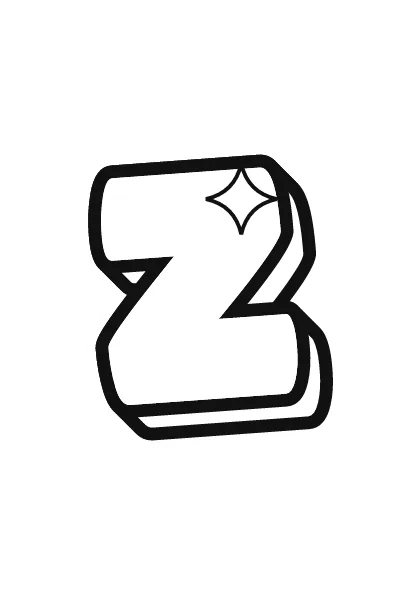
The PDF holds 26 pages, A to Z, with one big uppercase graffiti bubble letter centered on each page. The letters are black line art on white: thick outlines, no shading, no gray fill. That keeps them easy to color, cheap to print and clear enough for small hands to stay inside the lines.
Bubble letters were chosen on purpose. Their round, inflated shapes leave big open areas for color and have no thin spikes, so they work for a five-year-old with crayons and for a teenager with markers. For the sharper look of other styles, see the full graffiti alphabet, or the bubble letters guide to learn how the same shapes are drawn by hand.
Make a coloring page of any name
Names, words and short phrases can become a coloring page in under a minute:
- Open the graffiti generator and type the name.
- Choose a style. Bubble and 3D work best for coloring.
- Press Print as a coloring page. It downloads an A4-sized PNG at print quality, black outlines on white, portrait for short words and landscape for long ones.
- Print it with Fit to page on, on A4 or US Letter paper.
Need numbers too, for a birthday or a class year? The graffiti numbers page has 0–9 in the same styles.
How do you color graffiti letters?
Color graffiti letters in layers: a fill with a fade, a darker 3D side, white highlights, and a crisp black outline at the end. Five steps:

- Fade the fill. Use a light color at the top of each letter and a darker one at the bottom, blending where they meet. Yellow to orange, or light blue to dark blue, always works.
- Color the 3D side darker. If you draw a block behind each letter, make it a deep shade of the fill color, or dark gray.
- Add white highlights. A white gel pen or white paint marker along the top-left edges makes letters shine.
- Go over the outline. A black marker on the outline makes everything crisp at the end.
- Add drips, stars or a background. Bricks, clouds or a sunset behind the letter turn a plain sheet into a small piece.
Picking colors is half the fun. Two neighbors on the color wheel, such as yellow and orange, give a smooth fade. Opposite colors, such as a blue fill with an orange glow around the outline, make the letters pop. The graffiti ideas page has more color and word combinations to try.
What should you color graffiti letters with?
Colored pencils are best for smooth fades and younger kids. Felt-tip markers give bold, flat color fast. Paint markers and gel pens are for white highlights on top. Most finished pages mix all three.
- Colored pencils: start with light pressure and build up. Blend two colors by overlapping them where they meet.
- Washable felt-tips: color in one direction to avoid streaks, and put a scrap sheet underneath in case of bleed.
- Alcohol markers: the smoothest blends, but they soak through copy paper. Use thick paper and a backing sheet.
- Crayons: fine for ages 3–6. Press harder on the bottom half of each letter for an easy fade.
- Paint markers: opaque white and metallic colors for highlights and outlines. The graffiti markers guide covers which ones work on paper.
Graffiti coloring pages for the classroom
Graffiti letters get kids excited about writing and design, and the printable alphabet fits easily into an art or literacy lesson. A few ideas for teachers and parents:
- Name tags. Each child colors the letters of their own name on the first day.
- Alphabet wall. Give each child one letter; together the class builds an A–Z display.
- Bulletin board titles. Print the letters of a heading and let the class color them.
- Letter recognition. Younger children find and color the letters in their name or a weekly spelling word.
- Art lesson. Teach outline, fill, light source and 3D, then let students add highlights and drips of their own.
- Street art talk. Older students can discuss graffiti as an art form, murals, and why artists paint legal walls or ask permission first.
Which activity suits which age?
- Ages 3–4: crayons on their first initial, with plenty of help and stickers.
- Ages 5–7: color one letter, then add stars, dots or a simple background.
- Ages 8–11: color their whole name and try a two-color fade and white highlights.
- Ages 12 and up: design their name in the generator, print it, then add 3D, drips and shading by hand.
- Adults: use the pages as a relaxed warm-up before drawing letters freehand in a sketchbook. The how to draw graffiti guide is the next step.
How to print graffiti letters
Open the PDF, choose the page or pages you want, and print with Fit to page turned on. The pages are A4, so this setting matters on US Letter paper; without it the edges can be cut off.
- Print a few letters: type the page numbers in the print dialog. A is page 1, B is page 2, and so on.
- Save ink: print in black and white or grayscale. The pages are line art, so nothing is lost.
- Use thicker paper: 65–110 lb cardstock stops markers bleeding through and holds up on a wall display.
- Make a banner: print each letter of a word on its own page and tape them side by side.
Want letters to cut out and spray through instead? The stencil letters page has an A–Z stencil PDF built the same way.
More printable bubble letters
For simpler outlines to trace or cut out for a banner, the printable bubble letters page has uppercase A–Z, lowercase a–z and numbers in separate PDFs. Add an age or a year with the bubble numbers 0–9 PDF. Children still learning to write their name can practice first with a free name tracing worksheet.